Table Tennis Touch
- 4.1
- Rating
- 10.00M
- Installs
- Free
- Price
 Analysis by App-foxy
I approached Table Tennis Touch expecting a quick sports game rather than a full simulation, and that is exactly where it makes the most sense. It puts table tennis into short, focused sessions that are easy to start and simple to understand, while still asking for more timing and attention than a casual tap game. I found it especially comfortable when I wanted something active for a few spare minutes without committing to a long match or complicated setup.
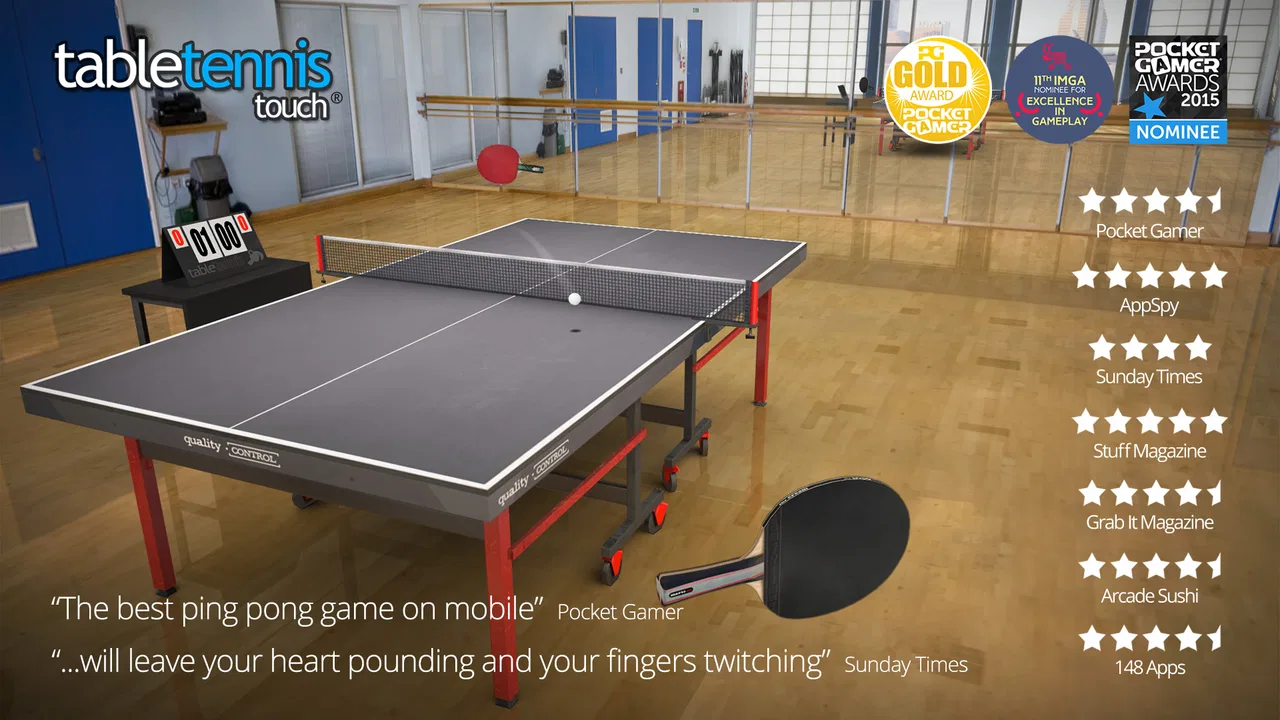
Developed by Yakuto, this free sports game is built around the familiar idea of table tennis, but its appeal comes from how directly it gets to the action. The store summary presents it as an offline ping pong game, and that offline focus is important: you can use it when you are away from a reliable connection instead of treating it like a game that constantly depends on online access. That makes it a practical choice for travel, waiting rooms, or a quiet break when I do not want to spend time browsing menus.
How Table Tennis Touch feels in everyday play
I find the everyday appeal lies in how little preparation a session needs: I can focus on one rally without setting aside time for a long sports game. The useful test is whether tracking the ball and timing a return feels satisfying on your phone, since that interaction carries the experience. From there, it makes sense to look at how each exchange gives me feedback and encourages another attempt.
You May Also Like

 Google Keep - Notes and lists
Google Keep’s Quiet Growth Shows the Appeal of Simpler Notes
As mobile work gets busier, Google Keep keeps winning a simple contest: capture a thought quickly, find it later, and get on with the day.

 Blood Strike: 2.5 Anniversary
Blood Strike’s Loadouts Turn Every Drop Into a Tactical Gamble
A close look at Blood Strike’s custom loadouts: how fast access to signature weapons reshapes its battle royale rhythm, rewards preparation, and narrows the gap between fights.

 Pandora - Music & Podcasts
Pandora’s Music Is Easy to Start, but Harder to Recover
Pandora’s strength is its low-effort path from a seed to a station. Its weak spot is how much confidence it asks you to place in connection, setup, and quiet recovery.

 8 Ball Pool
 Is Built on Rivalries, Rematches, and Routine
A close look at the rivalries, rematches, shared routines, and unanswered safety questions that turn a quick pool match into a persistent mobile community.

 Samsung Music
’s Quiet Strength Is Playing What You Already Own
Its reach comes less from spectacle than from dependable access to a personal library. That simplicity is both the app’s strongest retention engine and its ceiling.

 AccuWeather: Weather Radar
AccuWeather Review: A Quick, Clear Forecast for Everyday Decisions
For everyday plans, the best forecast is the one you can understand quickly. AccuWeather makes rain timing, radar, and local conditions easy to act on, with a few trade-offs.
More From Our News Desk



Quick starts and a pace that rewards attention
The first thing I noticed is that the game feels designed for immediate play. Table tennis is naturally suited to short exchanges, and a mobile version benefits from that rhythm. I can pick it up for a brief session, concentrate on the ball, and put it down without feeling that I have abandoned a large open-world activity or interrupted a long story sequence. That makes the game a better fit for small gaps in the day than many sports titles that require a full match before they feel worthwhile.
The perceived speed depends heavily on how carefully I watch the ball. At an easy pace, the action feels approachable, but faster exchanges demand earlier reactions and more deliberate movement. This gives the game a useful middle ground: beginners can understand what is happening, while experienced players can still find pressure in a rapid rally. I would not describe it as slow, but it is also not trying to overwhelm the player immediately with an arcade blur.
A useful habit is to focus on the incoming ball rather than repeatedly tapping in anticipation. That small change makes the controls feel more predictable and helps me react to the direction of the return. It also exposes one of the game’s main trade-offs: success depends less on random button pressing and more on maintaining visual attention. If I am distracted, even a short match can become frustrating.
The simple presentation works in its favor here. I do not need to remember a large control scheme before starting. The basic table tennis idea remains recognizable, so the learning curve comes from timing rather than from memorizing a collection of special commands. For someone who wants a sports game that explains itself through play, that is a strong advantage.
What happens during longer or heavier sessions
Short sessions are where I think the game is most comfortable. During a longer stretch of play, the repeated focus on timing can become mentally tiring even when the individual matches are not lengthy. That is not a flaw unique to this title; table tennis itself is built around constant attention. Still, it means I would not choose it as a relaxed background game while watching a show. It asks me to look at the screen and respond, especially once the pace rises.
The heaviest use case is not a single match but a sequence of attempts when I am trying to improve. Repeating the same kind of exchange can make small control mistakes more noticeable. A missed return that feels harmless in a casual round may become irritating after several attempts, particularly if I am playing while tired. I found that taking a short break is more useful than forcing another immediate retry, because the game rewards fresh concentration.
For an everyday scenario, imagine using it during a train journey with no dependable connection. I can launch an offline sports game, play a few focused rounds, stop when my station approaches, and return later without needing the social commitment of a multiplayer session. That is a more convincing use case than treating it as a replacement for a real table tennis club. It provides convenient practice-like interaction and entertainment, but it cannot reproduce the physical movement, spin feedback, or social energy of playing across a real table.
Another practical tip is to avoid judging the game after only a few rushed attempts. The controls may feel more natural once I stop trying to react at the last possible moment. Reading the ball early is more valuable than frantic input, and this is one of the less obvious differences between a satisfying session and a string of disappointing misses.
Reliability and the value of offline play
The offline design is one of the clearest reasons to consider this particular game. Many mobile sports games are built around live services, online opponents, or a connection-dependent progression loop. Table Tennis Touch is easier to fit into disconnected situations because its core appeal does not require me to be online. That makes it useful on flights, in areas with weak reception, or when I simply want to reduce interruptions.
Offline play also changes how I think about reliability. I am not waiting for a match to fill, depending on another player to remain connected, or planning around an event that may no longer be available. I can treat the game as a self-contained activity. For a player who values predictable access more than competitive online features, that is a meaningful strength.
At the same time, offline convenience should not be confused with unlimited variety. A game that works without a connection is excellent for dependable access, but it may feel less socially engaging than a title centered on live competition. If my main goal is to challenge friends, compare rankings, or experience constantly changing online opponents, I would look toward a multiplayer-focused alternative instead.
The game has been available since March 11, 2015, and its current version is 3.7.0. That combination suggests a title with a long presence on mobile rather than a brand-new experiment. I see that as reassuring for someone who prefers an established game, although age can also matter when judging how fresh the presentation feels beside newer sports releases. The important point is that its basic identity remains clear: a focused table tennis game rather than a broad platform trying to cover every sports mode.
Device limits and what to expect from the download
The minimum operating system is Android 8.0, so compatibility is not aimed at very old Android devices. Anyone using an older phone should check the system requirement before planning around it. On a supported device, the game’s focused nature should make more sense than a large, content-heavy sports package, but I would still avoid assuming that every phone will deliver the same feel. Screen size, touch responsiveness, and the condition of the device all influence a timing-based game.
A small screen can make the ball harder to follow during quick exchanges, especially if I hold the phone at an awkward angle or play in bright outdoor light. A larger display may make visual tracking easier, but it does not automatically make the controls better. Touch response matters more than screen size alone. If my phone already feels inconsistent with other fast gestures, I should expect that weakness to be more noticeable here because a late or missed input can directly affect a return.
Resource demands are best considered in practical terms rather than by chasing a single performance claim. This is a dedicated sports game with a narrow focus, not a large open-world title. I would expect it to be a more sensible choice for moderate hardware than a visually expansive game, but I would not promise identical smoothness across every supported phone. Keeping other demanding apps closed can be a sensible step before a longer session, particularly on an older device.
Battery use is also tied to session length and screen brightness. A few short rounds are a different situation from playing repeatedly for an extended period. I found it sensible to lower brightness when playing indoors and to avoid treating the game as an all-evening activity if battery life is a concern. These are ordinary mobile habits, but they matter more in a game where concentration encourages “just one more match.”
The age rating is Everyone, which matches the straightforward sports concept and makes it easier to recommend as a family-friendly game. That does not mean every player will enjoy it equally. Younger players may need time to develop the timing, while adults looking for a deep simulation may find the mobile format more compact than they want. The rating describes accessibility of content, not the difficulty of mastering the exchanges.
Free access, purchases, and the real trade-off
The game is free to download, with in-app purchases ranging from $0.99 to $2.99 per item. That makes it easy to try without paying at the start, which is valuable for anyone unsure whether a touch-based table tennis game will feel comfortable. I would recommend playing enough to decide whether the controls suit your hands before spending anything.
The important question is not simply whether purchases exist, but whether the free experience feels worthwhile on its own. For me, the answer depends on what I want from the game. If I mainly want short offline matches and a convenient sports distraction, the free entry point is appealing. If I expect a large stream of constantly changing content or a complete substitute for a console simulation, I may feel the limits sooner.
Because the purchase items are relatively low-cost individually, it is still worth keeping an eye on cumulative spending rather than judging each item in isolation. A good personal rule is to decide beforehand whether I am paying to improve convenience or simply reacting to a frustrating loss. That distinction helps preserve the game’s casual value and prevents a short offline pastime from becoming an impulse purchase.
Who will enjoy it, and who should choose something else
I think this is a good match for players who want a sports game that starts quickly, works offline, and revolves around one recognizable activity. It suits commuters, casual players, and anyone who enjoys improving through repeated timing rather than learning a complex roster or management system. It is also a reasonable choice for someone who wants a family-friendly game without an aggressive competitive atmosphere at its core.
I would be more cautious about recommending it to players who need deep career management, realistic physical simulation, or a strong online community. A real table tennis session is better for physical skill and social interaction. A console or PC sports simulation may be better for players who want richer presentation, broader modes, or more detailed control. A live multiplayer game may be preferable if the opponent matters more than the rally itself.
There is also a difference between wanting a relaxing game and wanting a simple game. Table Tennis Touch is simple to understand, but it is not always relaxing once the exchanges become demanding. If I want something I can play with minimal attention, a turn-based puzzle game would probably suit me better. If I want a compact challenge that rewards concentration, this title makes a stronger case.
My performance verdict
After looking at speed, longer-session comfort, offline reliability, and device considerations together, I see Table Tennis Touch as a focused mobile sports game rather than an all-purpose table tennis replacement. Its strongest quality is the directness of the experience: I can open it, understand the objective, and spend a short period concentrating on the next return. The offline angle gives it a practical role that many modern mobile sports games do not fill as neatly.
Its limitations are equally clear. Repeated play can become tiring, touch performance depends on the phone, and players seeking deep simulation or social competition may outgrow it. The free model is convenient, but I would still approach purchases thoughtfully rather than assuming every optional item is necessary. Those caveats do not undermine the game; they define the audience that will appreciate it most.
With a 4.1 average from around 134 thousand ratings and more than 10 million installs, it has clearly found a substantial mobile audience. I would not use popularity as a substitute for personal taste, but those figures fit my impression of a well-established, accessible sports game rather than a niche technical experiment. Yakuto has kept the concept easy to grasp, and the current version gives interested players a straightforward way to see whether the touch controls work for them.
My recommendation is simple: try it if you want quick, offline table tennis sessions that reward attention without demanding a large time commitment. I would skip it if your priority is a full simulation, physical exercise, or online rivalry. For the right player, it is a dependable little game to keep available for travel and spare moments; for everyone else, its focused design may feel more limited than inviting.
In my experience, the best way to judge it is to play with a steady grip, watch the incoming ball early, and test it during the kind of short break when you would realistically use it. If that rhythm feels satisfying, the game has enough immediacy to become a regular offline companion. If the touch timing feels awkward from the beginning, no amount of extra content will change the fact that its central appeal depends on that basic interaction.
FAQs for Table Tennis Touch
01What features does Table Tennis Touch offer?
Table Tennis Touch offers a range of features including realistic gameplay with intuitive swipe controls, a career mode to climb the ranks, multiple mini-games for quick fun, and multiplayer options to compete with friends. The game also boasts stunning graphics and a variety of customizable paddles and environments.
02Is Table Tennis Touch available for both Android and iOS?
Yes, Table Tennis Touch is available for both Android and iOS platforms. Users can download it from the Google Play Store for Android devices and the Apple App Store for iOS devices. The game offers a seamless experience across both operating systems, ensuring all users can enjoy its features.
03Does Table Tennis Touch require an internet connection to play?
Table Tennis Touch can be played offline in its single-player modes, making it perfect for on-the-go gaming without worrying about connectivity. However, an internet connection is required for multiplayer modes and to access leaderboards and updates, enhancing the competitive aspect of the game.
04Are there any in-app purchases in Table Tennis Touch?
Yes, Table Tennis Touch includes in-app purchases. While the game can be enjoyed without spending money, players have the option to purchase additional items like special paddles or to remove ads. These purchases can enhance the gaming experience but are entirely optional.
05How does the multiplayer feature work in Table Tennis Touch?
The multiplayer feature in Table Tennis Touch allows players to compete against friends or other players online. It offers a real-time competitive experience, with the ability to challenge opponents worldwide. Players can track their progress on global leaderboards, adding a competitive edge to the gameplay.
Pros
- High-quality graphics enhance gameplay.
- Intuitive controls for easy play.
- Variety of challenging modes.
- Realistic physics for authentic experience.
- Engaging career mode with progression.
Cons
- Limited customization options.
- Requires internet for some features.
- Occasional lag in multiplayer mode.
- In-app purchases can be costly.
- Lacks offline multiplayer option.

Table Tennis Touch
Gallery